
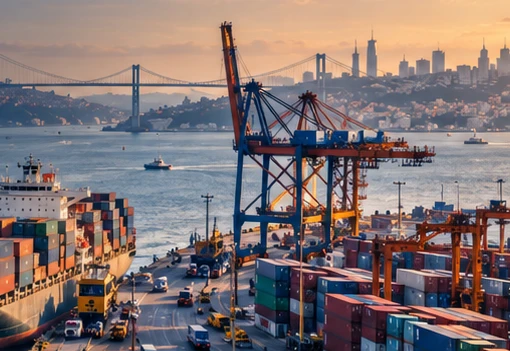
The European Union’s Carbon Border Adjustment Mechanism, commonly known as CBAM, marks the beginning of a new era for industrial companies exporting from Türkiye to EU countries.
CBAM goes beyond environmental regulation. It directly affects export pricing, product carbon intensity, customer relationships, preparation of emissions data, verification processes and commercial contracts.
Companies manufacturing products covered by CBAM, particularly iron and steel, cement, aluminium, fertilisers, electricity and hydrogen, now need to consider carbon costs as part of their export strategy.
What Is CBAM?
CBAM is a mechanism that applies a carbon cost to the greenhouse gas emissions embedded in the production of certain goods imported into the European Union.
Its main purpose is to reduce potential competitive differences between producers facing carbon costs within the EU and producers outside it.
In other words, the EU does not want the carbon costs its industrial companies face under the EU Emissions Trading System to go entirely unmatched for imported products.
The embedded carbon emissions of goods imported under CBAM are therefore determined, and an obligation to surrender CBAM certificates arises under certain conditions.
One point deserves particular attention:
CBAM is not a fixed percentage tax on the value of a product.
CBAM costs vary with the product’s emissions intensity, the import period, the applicable calculation rules and any adjustments that may apply.
How Is the CBAM Certificate Price Determined?
The European Union Emissions Trading System, or EU ETS, underpins the CBAM certificate price.
Businesses operating under the EU ETS must surrender emissions allowances corresponding to their greenhouse gas emissions.
An emissions allowance generally represents:
1 tonne of CO₂-equivalent emissions.
CBAM certificate pricing is also linked to prices in the EU ETS carbon market.
In 2026, CBAM certificate prices are determined quarterly; weekly pricing is envisaged from 2027 onwards.
It is therefore incorrect to treat any daily EUA market price as the CBAM certificate price.
CBAM Certificate Prices in 2026
The certificate prices announced during 2026 clearly show that carbon costs can change over time.
According to the figures published by the European Commission:
- January–March 2026: €75.36 per certificate
- April–June 2026: €75.28 per certificate
- July–September 2026: €82.32 per certificate
The relevant consideration here is the period in which the product was imported into the EU, rather than the date on which the certificate was purchased.
For example, suppose the calculation for an import transaction results in a requirement for 1,000 CBAM certificates.
Using the July–September 2026 certificate price of €82.32:
1,000 × €82.32 = €82,320
would be the resulting carbon cost.
However, 1,000 certificates do not directly mean 1,000 tonnes of product.
The certificate requirement is calculated using several factors, including embedded emissions, applicable adjustments, the effect of free allocation and any carbon price paid in the country of production.
Does the Turkish Exporter Pay the CBAM Cost?
This is one of the most frequently misunderstood aspects of CBAM in Türkiye.
The party responsible for surrendering CBAM certificates on the EU side is the authorised CBAM declarant.
This is generally:
- the EU importer,
- or, where the necessary conditions apply, an authorised indirect customs representative.
A producer operating in Türkiye therefore does not automatically become directly responsible for purchasing CBAM certificates simply because it exports to the EU.
However, the legal obligation and the economic cost must be distinguished.
Even if the importer purchases the certificates, the resulting cost may be passed on to the Turkish producer in various ways.
The EU customer may:
- absorb the carbon cost,
- reflect it in its selling price,
- request a price reduction from the Turkish producer,
- or seek to share the carbon cost.
CBAM will consequently become an important commercial negotiation issue, as well as an environmental regulatory matter.
How Are CBAM Costs Calculated?
The certificate price alone is insufficient to calculate CBAM costs.
A simplified relationship is:
CBAM cost = number of CBAM certificates to be surrendered × certificate price for the relevant period.
To determine the certificate requirement, the product’s embedded emissions must first be calculated correctly.
Companies therefore need to consider the following together:
- whether the product is within CBAM scope,
- correct identification of the CN code,
- embedded emissions at product level,
- direct and, where required, indirect emissions in the production process,
- the emissions factors used,
- possible adjustments relating to carbon prices,
- the import period,
- and the applicable EU calculation rules.
Will Every Exporter Face the Same CBAM Cost?
No.
Even companies operating in the same sector may face significantly different CBAM costs.
CBAM obligations are not determined solely by a sector’s name.
The assessment is carried out at product level.
The product’s CN code is particularly important.
For example, a company may operate in the iron and steel sector without every product it exports automatically falling within CBAM scope.
Exporters should therefore begin by checking their products’ customs tariff codes.
The quantity imported into the EU and the importer’s total annual imports may also affect the assessment of obligations. The annual 50-tonne net import threshold is relevant to certain product groups. This threshold does not apply to imports of electricity or hydrogen.
CBAM and Commercial Contracts
Commercial contracts are one of the areas where CBAM will bring significant changes for companies.
Companies regularly exporting to the EU should clearly specify in their sales contracts how carbon costs will be shared.
Contracts should clearly define:
- who will prepare emissions data,
- when the data will be shared,
- who will bear verification costs,
- who will cover the CBAM certificate cost,
- how differences between estimated and actual costs will be managed,
- who is responsible for incorrect or incomplete emissions data,
- and how long the required records will be retained.
General wording such as “the seller bears the CBAM cost” may lead to significant disputes between the parties in the future.
Does the Customs Union Exempt Türkiye from CBAM?
The Customs Union between Türkiye and the EU does not automatically exempt Türkiye from CBAM.
Existing trade agreements likewise do not remove CBAM obligations automatically.
The strong trade integration between Türkiye and the EU may be relevant to future discussions.
Under the current framework, however, Türkiye has no general CBAM exemption.
Assuming that CBAM does not apply because of the Customs Union could therefore create serious regulatory and trade risks for companies in Türkiye.
The Relationship Between the Turkish ETS and CBAM
Türkiye’s development of a national Emissions Trading System is also highly relevant to CBAM.
Under CBAM, a carbon price actually paid in the country of production may be taken into account under certain conditions.
If an industrial company incurs a carbon cost under the Turkish ETS, that payment may therefore become relevant to the assessment of its CBAM obligations.
Establishing the Turkish ETS does not, by itself, mean:
- that Turkish products will be exempt from CBAM,
- or that the Turkish carbon price will be directly deducted from the CBAM price.
The carbon price must actually have been paid, be attributable to the relevant product and be supported by the necessary chain of documentary evidence.
Exporting industrial companies will therefore need to monitor the relationship between the Turkish ETS and CBAM closely.
How Should Turkish Industry Prepare for CBAM?
The main priority is to establish a sound carbon data infrastructure within the company, alongside monitoring regulatory developments.
Companies exporting to the EU should undertake the following work:
1. Analyse product scope.
Check whether the exported products match the CN codes covered by CBAM.
2. Calculate carbon emissions at product level.
Calculate the embedded emissions generated during production of the exported product, rather than relying solely on the facility’s overall carbon footprint.
3. Establish a data infrastructure.
Systematically track fuel consumption, electricity use, raw material quantities, production data and relevant emissions sources.
4. Ensure emissions calculations can be verified.
The data used in calculations should be traceable retrospectively and supported by documentation.
5. Establish a data-sharing process with EU customers.
Agree in advance on the format and sharing dates for information requested under CBAM.
6. Review commercial contracts.
Clearly specify which party will bear carbon costs and under what conditions.
7. Plan carbon reduction investments.
Energy efficiency, renewable energy, alternative fuels, process improvements and low-carbon raw materials will become increasingly important in reducing CBAM costs.
CBAM Is Now a Competitiveness Issue
It is insufficient to view CBAM solely as a new environmental obligation or an additional cost.
The mechanism makes product carbon intensity an important factor in international trade.
Of two companies producing the same product, the one with lower carbon intensity may gain advantages beyond environmental performance:
product pricing, export competitiveness and customer preferences.
The central question for companies should therefore go beyond:
“How much will we have to pay because of CBAM?”
The question should be:
“How can we reduce our product’s carbon intensity and gain a carbon-related cost advantage in exports?”
Tüm Çevre CBAM and Carbon Management Services
With more than 20 years of environmental management and industrial consulting experience, Tüm Çevre manages carbon compliance through a technical, practical approach.
Our CBAM and carbon management consulting services for industrial companies cover:
- CBAM scope analysis,
- CN code and product assessment,
- embedded emissions calculations,
- corporate carbon footprint studies,
- product carbon footprint calculations,
- ISO 14064-1 greenhouse gas calculation and reporting,
- establishment of emissions data infrastructure,
- development of MRV systems,
- preparation of carbon data for EU customers,
- Turkish ETS and CBAM compliance consulting,
- and development of carbon reduction strategies.
For businesses exporting to the EU, we believe that CBAM work should be treated as part of the company’s production, finance and export strategy, alongside its reporting activities.
Tüm Çevre
Environmental, Carbon and Sustainability Consulting
Sources
Official sources for certificate prices and the applicable rules. Last checked: 5 October 2026.